
Buying guide · 7 min
Fresh-roasted coffee beans: what to check before you buy
Roast date, current crop and a traceable lot decide how much of the origin reaches the cup. A practical shelf guide.
By the roast bench · Arhetyp Coffee Roasters
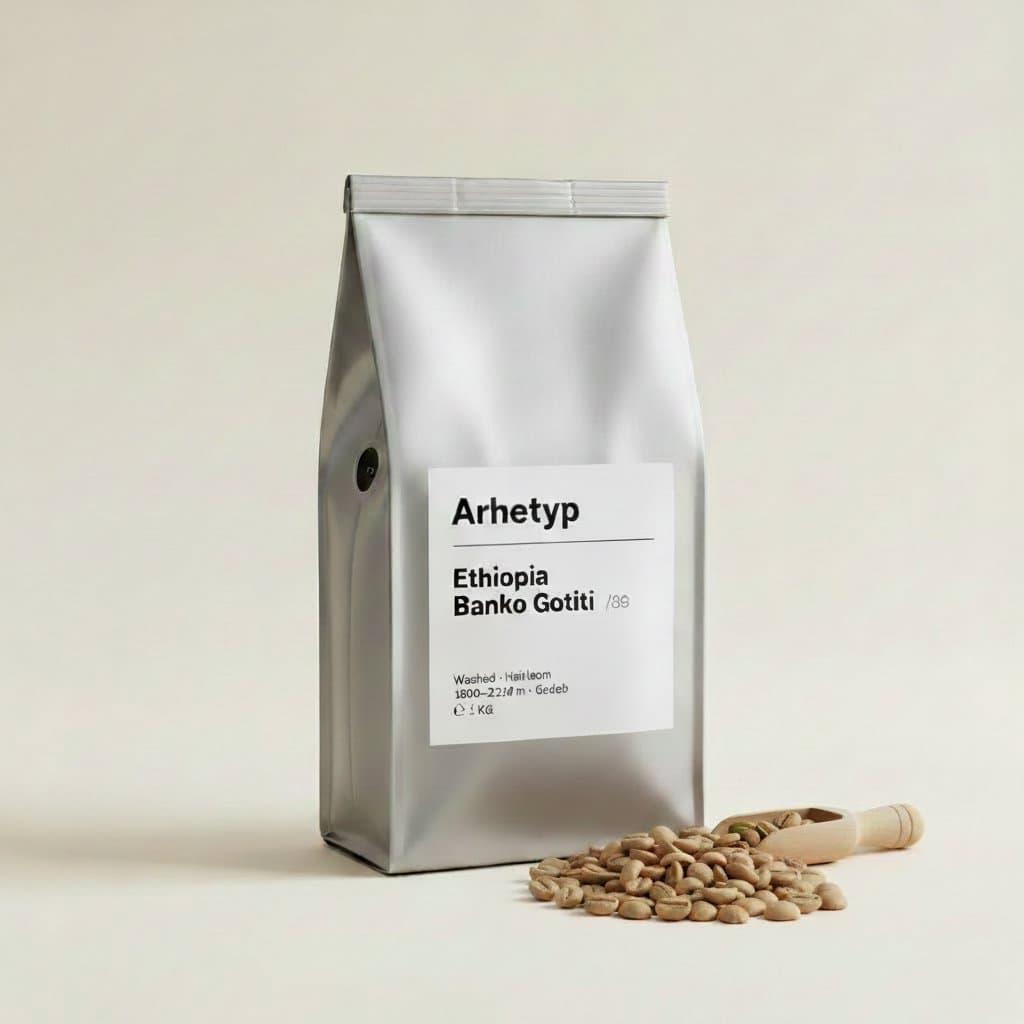
Coffee beans degrade in days, not years. A bag without a roast date hides the one detail that matters most. This guide covers what to check on the shelf, ordered by impact on the cup.
Specialty coffee is sold on freshness, not shelf life. Read the label the way you would read a spec sheet.
The order of the markers is not random. Roast date and crop set the potential; the rest preserves it. A very good coffee roasted three months ago arrives already tired.
Roast date beats best-before
Look for the roast date, not the expiry date. A 12-month best-before never tells you when the beans were roasted. The optimal window for drinking sits between 21 and 30 days after roast. After roasting, beans release carbon dioxide and slowly lose volatile aromatics. By day 60, a filter coffee loses clarity. By day 90, fruit notes fade noticeably. Every Arhetyp bag carries a printed roast date.
Some roasters print a lot code next to the date. The code links the bag to a roast batch and an origin sheet. A long best-before on the shelf is a warning signal.
Buy at a cadence that matches how you drink. Two filter drinkers finish 250 g in 10-14 days. A monthly subscription syncs delivery to the roast, not the warehouse. Large chains hide the date because they rotate stock slowly. A small roaster sells what it roasted this week.
Why current crop changes the cup
Green coffee is not stable forever. Raw beans lose quality after roughly 12 months from harvest. A past-crop lot loses acidity and turns woody and papery. Current crop keeps bright acidity and fruit sweetness. Serious roasters state the harvest year on the lot. Ask for current crop, especially for washed Ethiopians and Kenyans. Ethiopia Banko Gotiti in the shop is traced to the current crop.
Harvests shift by hemisphere and altitude. Ethiopia and Kenya pick between October and February. Central America runs November to March. A good lot sells out fast and returns seasonally.
How green beans are stored matters just as much. Green coffee is kept in barrier bags at controlled humidity. A badly stored lot ages faster than the calendar suggests. So the stated crop is only half the story. The other half is how soon it was roasted after import.
Origin and a traceable lot
A traceable coffee tells you where it comes from. Look for five markers: country, region, altitude, variety and process. Altitude between 1,800 and 2,200 metres correlates with denser acidity. Washed processing gives clarity; natural gives body and fruit. Variety hints at the aromatic profile you should expect. A lot without region or altitude is usually a commodity blend.
Banko Gotiti lists the Gedeb region, altitude above 1,900 metres, Heirloom varieties and a washed process. From that, you can expect citric acidity and medium body. Without it, you buy blind. The single origin coffees in the shop list these markers on each lot sheet.
An SCA cupping score above 80 points defines specialty coffee. Many lot sheets list the score and the tasting notes. Direct trade shortens the chain between farm and roaster. Fewer links mean cleaner information about the lot. Ask for the origin sheet if it is not printed on the bag.
A declared roast profile
Roast level changes the cup entirely, with the same beans. A light roast keeps acidity and origin character. Look for the declared use: filter, espresso or omni. Technical notes help: a drop temperature near 196-205°C and 15-20% development. Arhetyp roasts light, with first crack around 196°C. The Casa No. 7 blend is calibrated for espresso, with a slightly longer development.
Light roasting rewards careful extraction and good water. Dark roasting masks defects but erases acidity and fruit. Choose the profile to match your method, not the other way round.
Tasting notes on the bag are a map, not a promise. They describe the aromatic direction at a correct extraction. Water matters: 90-96°C for filter, moderate mineral content. Water that is too hard flattens the acidity of a light roast. Test one method before judging the beans.
The one-way valve and degassing
The valve on the bag is not decoration. It lets carbon dioxide out and blocks oxygen from entering. Without a valve, the bag either swells or holds stale coffee. After roasting, beans degas actively for 24-72 hours. For filter, wait 3-5 days before the first brew. For espresso, rest the beans 7-14 days. Beans that are too fresh pull an uneven, sharp espresso.
A quick shelf test: press the bag gently near the valve. A fresh coffee smell means the seal is working. A completely flat bag suggests old coffee.
The bag material completes the valve. An opaque, barrier foil blocks light and moisture. A clear bag lets light oxidise the oils. Check the bottom seam too: a poor seal lets air in. The right packaging keeps oxygen out until you get home.
Grind at home
Ground coffee loses its aromatics in 15-30 minutes. Grinding at home, just before brewing, is the cheapest quality upgrade. A burr grinder gives an even particle size, essential for extraction. Set the grind by method: coarse for French press, medium for V60, fine for espresso. Buy whole beans, not factory-ground.
Blade grinders chop unevenly and heat the beans. Conical or flat burrs give consistency. A manual burr grinder is enough to start. That investment changes the cup more than an expensive machine.
Settings start from a reference and adjust to taste. If the brew tastes bitter, go coarser. If it tastes sour and thin, go finer. A few drops of water on the beans cut static during grinding. Clean the grinder monthly, since old oils spoil the new lot.
Store it correctly
Three factors degrade coffee: oxygen, light and heat. Keep beans in an airtight, opaque container at 18-22°C. Keep the bag away from direct light and kitchen heat. Do not store coffee in the fridge. The fridge creates condensation on every opening and beans absorb odours. The freezer works only for long storage, in sealed portions, not for daily use. Buy the amount you drink in 3-4 weeks.
The original valve bag works well if you close it tightly. Roll the top and clip it after each use. A 250 g bag covers about 16-20 filter cups.
Measure the ratio, not just the amount. For filter, 60 g of coffee per litre of water is a good reference. A scale gives consistency from cup to cup. Note the setting that worked, so you can repeat it. Freshness only counts if you extract with the same care.
Shelf checklist
- Roast date
- Printed, under 30 days old
- Crop
- Current crop
- Traceability
- Country, region, altitude, variety, process
- Roast profile
- Declared use: filter / espresso / omni
- One-way valve
- Present and working
- Format
- Whole beans, not ground
If two or more markers are missing, choose another lot.
V60 recipe for fresh coffee
- Coffee dose
- 15 g
- Water
- 250 g, 92-94°C
- Grind
- Medium, just before brewing
- Bloom
- 45 g water, 30-45 seconds
- Total time
- 2:30-3:00 minutes
- Rest after roast
- 3-5 days (filter)
Three mistakes are common among buyers. First, they choose the bag by price, not by roast date. Second, they buy a large amount and drink it over two months. Third, they keep beans next to the stove or in the fridge. Each one costs more than the price gap between lots.
Freshness is not a marketing detail. It is the variable that decides how much of the origin reaches the cup. Check roast date, crop and traceability, in that order. Grinding and storage are the part you control at home.