
B2B guide · 8 min
How to choose a specialty coffee supplier for your cafe
Four criteria you can measure, the questions to ask at the sample cupping, and the contract clauses that keep a cafe supplied.
By the roast bench · Arhetyp Coffee Roasters
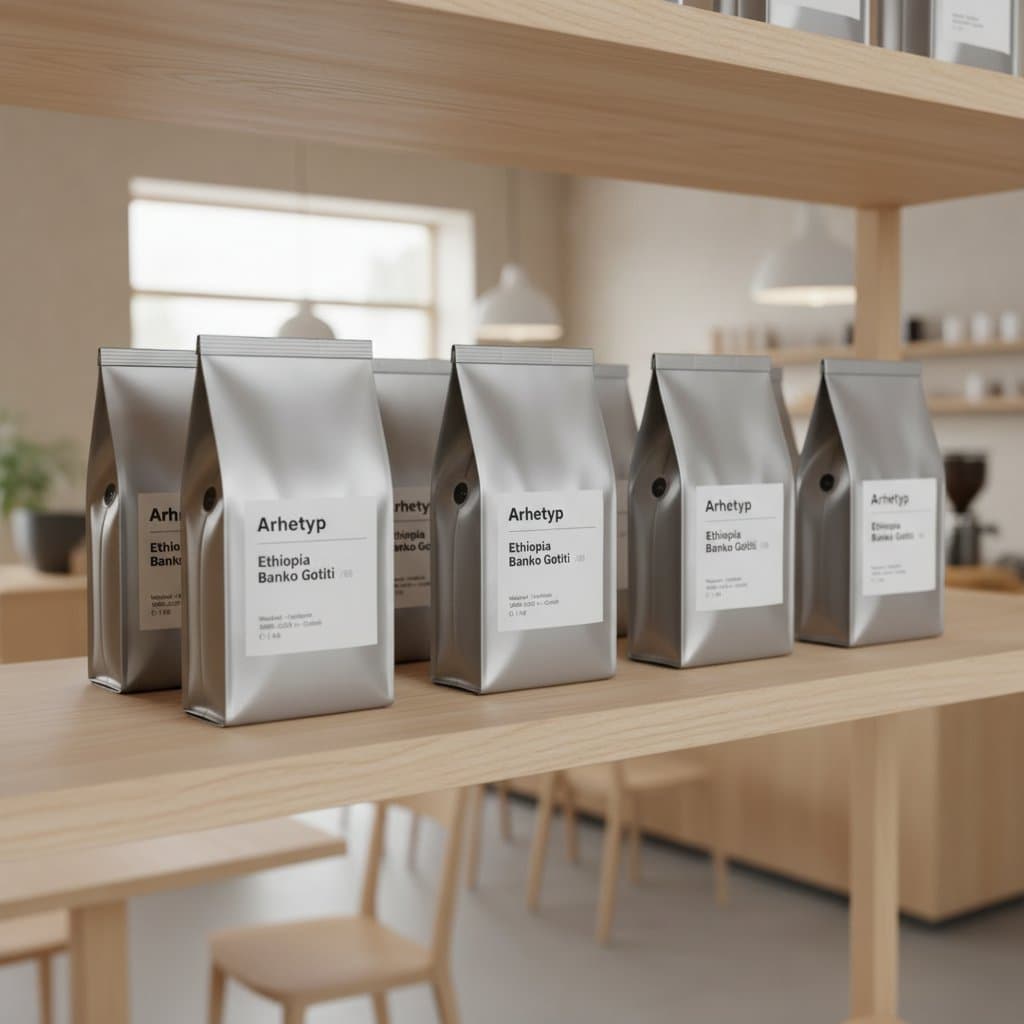
You choose a supplier by checking four measurable things. The roast date printed on every bag, lot traceability back to the farm, a taste profile that stays constant across deliveries, and a delivery term written into the contract. Barista training and sample cuppings show whether the supplier invests in your cafe or just sells sacks.
Most supplier pages read the same. Devoted roasters, hand-picked beans, care in every cup. None of that survives contact with a busy service. What follows is a checklist you can apply to any supplier, competitors included, and to us. Each item is something you can verify before you sign, not a feeling you have to trust.
Freshness is measured in days, not adjectives
A serious supplier prints the roast date on every bag. Not the month, not "recent", the exact day. Coffee releases carbon dioxide after roasting. For espresso, extraction stabilises between day 7 and day 21. For filter methods, the useful window runs from day 10 to day 28. A bag with no date leaves you guessing where you are in that range.
Ask about harvest too. Green coffee has a season, like any fruit. An Ethiopia from the current crop tastes different from one that is 14 months old. At Arhetyp we work with current-crop lots, and the roast date goes on the bag without exception. That lets you plan stock rotation instead of guessing it.
Lot traceability: farm, process, altitude
Traceability is operational information, not marketing. A supplier who knows the farm, the process and the altitude can explain why the taste shifts. When a lot runs out, you compare the next one against real data rather than impressions.
Take one example from the shop. Ethiopia Banko Gotiti arrives washed, around 2000 metres, with a named processing station. These details are not decoration. They predict acidity, body and how the coffee behaves at 93°C in the machine.
Ask what happens when a lot is finished. A good answer names the successor lot and its profile differences. A weak answer is "we will send something similar". Similar cannot be reproduced in the cup without data.
Traceability also tells you how the coffee was bought. A supplier who names the station and returns to the same producers year after year has a stake in quality. That relationship is what makes the next crop predictable. Ask how long they have worked with each origin. A one-season spot buy behaves differently from a standing relationship.
Profile consistency across deliveries
Your cafe serves the same drink dozens of times a day. The customer returns for a taste they recognise. If the profile jumps between deliveries, the barista recipe stops holding and complaints rise.
Consistency comes from controlled roasting and stable lots. Ask whether the supplier works to documented roast curves. An espresso blend such as Casa No. 7 has to give the same base week after week. Single origin varies more between lots, and a supplier should tell you that in advance.
Freshness and consistency benchmarks
- Espresso, minimum rest
- 7 days off roast
- Espresso, optimal window
- day 7–21
- Filter, optimal window
- day 10–28
- Roast date on bag
- required, exact day
- Profile variance across lots (blend)
- kept minimal, curve documented
- Green coffee
- current-crop lot
Benchmarks follow standard specialty degassing practice; tune to your machine and recipe.
Logistics is a clause, not a promise
The brochure says fast delivery. The contract says what happens when it fails. That difference decides whether you run out of coffee on a busy Saturday.
Ask for a firm term in working days, from order to door. Ask for the frequency: weekly, fortnightly, on demand. And ask for the delay clause: who covers express shipping if the supplier misses the term. A roaster who roasts to order can sync delivery with the roast date, so bags arrive fresh rather than rested in a warehouse.
Estimate consumption before you negotiate. A mid-traffic cafe serves 120–180 drinks a day. At an 18 g espresso dose, that is 2.5–3.5 kg a day, roughly 60–80 kg a month. With the number in hand, you negotiate the right frequency instead of an imposed one.
Ask about bag size and storage too. Whole beans in a 1 kg valve bag, opened only as you grind through them, hold their profile better than a big open hopper left overnight. Match delivery frequency to what you consume in one to two weeks. Ordering a month at once to save on shipping means the last bags are past their window before you open them.
Barista training and cupping samples
Turnover in cafes is high. A new barista has to be calibrated on your coffee, or the first week produces inconsistent espresso. Ask whether training is included or an add-on, and how many hours it covers for each new lot or hire.
Samples show intent. Before signing, ask for a tasting with at least three origins. At Arhetyp we send a cupping sample of three lots, so you dial in the recipe on your machine, not ours. If a supplier refuses a sample, that tells you something about the relationship ahead.
Bring seven questions to the sample cupping. One, what is the roast date on each sample. Two, what is the current crop year for each origin. Three, what is the recommended espresso recipe, dose, ratio and time. Four, how much does the profile vary between lots. Five, what is the firm delivery term in working days. Six, is training included, and how many hours per hire. Seven, what happens when a lot runs out. Answers with numbers are a signal. Answers with adjectives are a warning.
The contract: exclusivity, NET 30, exit
Three clauses matter more than the listed price. Exclusivity: if it is asked of you, what you get in return. Payment term: NET 30 gives you a month of trading before you pay, which matters for a new cafe's cash flow. Exit: how much notice, and what happens to remaining stock.
For a restaurant with 80 seats, consumption is lower than a pure cafe, around 20–35 kg a month depending on how much coffee sits in the menu. At that volume, fortnightly delivery with one espresso blend plus one rotating origin covers the menu without waste.
Recommendation by volume
- Mid-traffic cafe (120–180 drinks/day)
- 60–80 kg/month, weekly delivery
- Restaurant, 80 seats
- 20–35 kg/month, fortnightly delivery
- New opening, uncertain volume
- start without a rigid minimum, adjust at 30 days
- Payment term
- NET 30 for cash flow
- Exit notice
- clear in contract, with stock terms
Check any supplier against the criteria above, including us. If you want to start with data in hand, ask for a three-origin cupping sample from the shop and compare on your own machine. The Arhetyp wholesale programme carries the roast date on every bag, per-lot traceability, and training on each new origin.