
Guides · 8 min
Single Origin vs Blend: When Each Makes Sense
Single origin for clarity on filter, blends for consistency in espresso. The criteria, ratios and recipes that decide it, case by case.
By the roast bench · Arhetyp Coffee Roasters, Bucharest
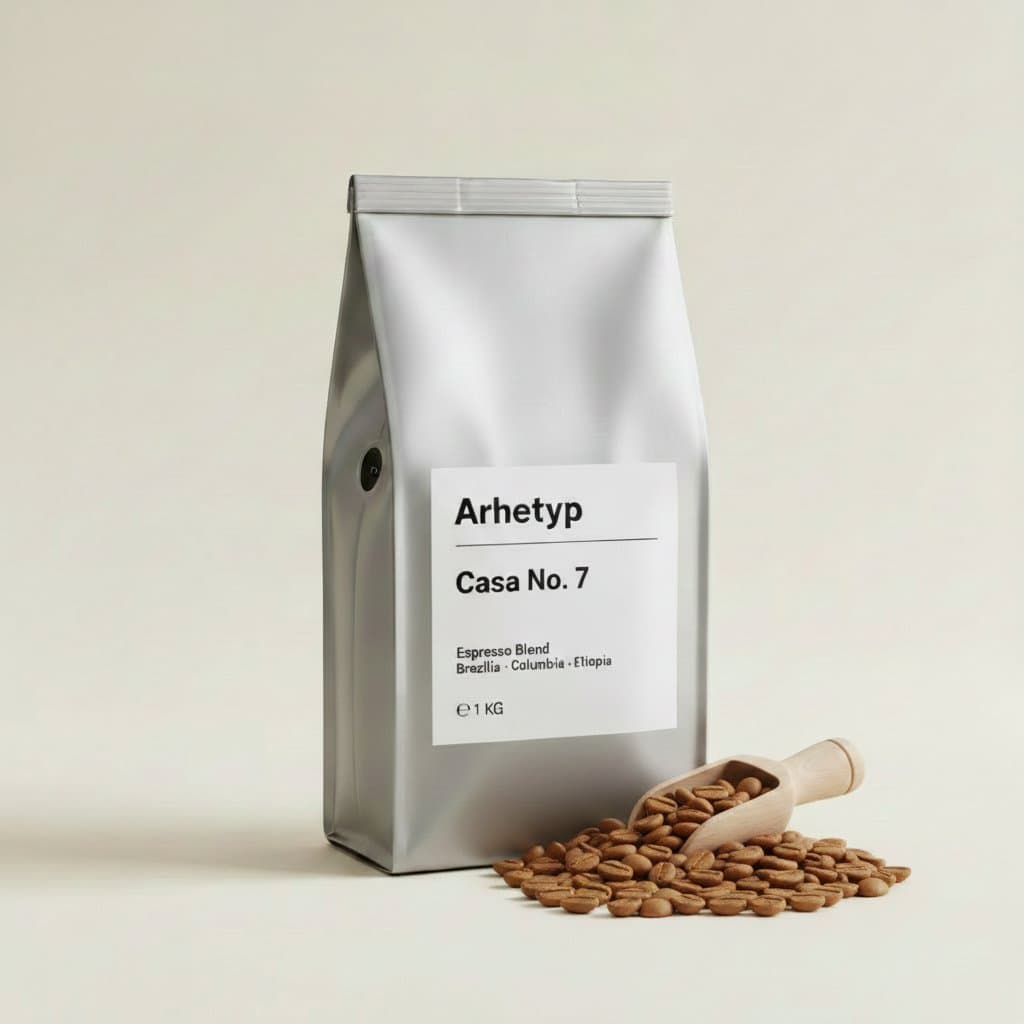
Single origin or blend. The question comes up with every bag of beans, and most answers online pick a side. Ours does not. The choice depends on the situation: which method you brew, how often, and for whom.
This guide puts the criteria on the table, with numbers. Extraction ratios, water temperatures, cost per shot. By the end you know what to buy for home filter, for daily espresso, or for a bar pulling 200 drinks a day.
The difference, in short
A single origin comes from one place: a country, a region, often one farm or one washing station. A blend combines two to four origins in fixed proportions. Single origin shows the character of a place and a harvest. A blend targets a stable profile, repeatable lot after lot.
A useful analogy: single origin is a solo voice, a blend is a chord. Neither is the lesser version of the other. Both start from the same condition: new harvest, recent roast, roast date printed on the bag.
What a well-built blend looks like
A working blend has two to four components, each with a defined role. One builds body and sweetness. One brings acidity. One adds the aromatic top layer. Past four components, roles start to overlap and control disappears.
Our Casa No. 7 blend runs three components at 60/30/10. The 60% share builds body and a chocolate base. The 30% share lifts acidity. The 10% adds the aromatic layer on top. Roasting stops at 209 °C, the point where sweetness is developed and acidity stays intact.
The role structure has a practical payoff. When one harvest runs out, we replace a single component with an equivalent one. The profile holds, and the recipe on your machine stays untouched. That is the whole job of a blend: to change inside so the cup does not change outside.
When single origin wins: filter and clarity
Filter methods extract at ratios of 1:15 to 1:17. At 18 g of coffee to 300 g of water, the cup is dilute enough for detail to become readable: citric acidity, floral notes, a black-tea finish. Here single origin has a clear edge. There is no second component covering the first.
The second argument is harvest rotation. Coffee is an agricultural product with a season. An Ethiopia Banko Gotiti from the new harvest tastes different from last year's lot, even from the same station. For a daily filter drinker, that rotation keeps the cup interesting without changing method or recipe.
The roast style matters as much as the origin. We roast light, which keeps origin acidity and aroma in place. Water does the rest: 94 °C for washed coffees, 92 °C if the cup turns bitter. Moderate mineral content, around 80-120 mg/l, helps clarity.
In practice: if you brew V60, Aeropress or Chemex at home, buy single origin. Take the bag with the most recent roast date and drink it within the first month after roasting. Grind right before brewing; ground coffee loses aroma within minutes, not days.
When a blend wins: daily espresso, milk, cost
Espresso concentrates everything. At a 1:2 ratio, 18 g of coffee to 36 g of beverage, small variations become large ones. A blend absorbs lot-to-lot variation and leaves your recipe alone. Dial in once, then correct the grinder by one step when the shot drifts.
In milk, the gap widens. The high acidity of an Ethiopian single origin gets lost in 150 ml of steamed milk, or turns sour. The body component of a blend, 60% in the case of Casa No. 7, cuts through and keeps the coffee present in a flat white or cappuccino.
The last criterion is cost per shot. One kilogram yields roughly 55 double doses of 18 g. A blend built on an accessible base component lowers the cost per dose without lowering the profile. At two espressos a day, the difference shows up on a monthly basis, not a theoretical one.
Dialing in stays simple if you change one variable at a time. Keep the dose fixed at 18 g. Keep the ratio at 1:2. Move only the grind and time the shot. Write the grinder setting on the bag; the next bag from the same lot starts there, not from zero.
The decision matrix: three situations
The general rule reduces to three common scenarios. The table below covers them in one pass.
Situation → choice
- Home, filter (V60, Aeropress, Chemex)
- Single origin. Harvest rotation, ground right before brewing.
- Home, daily espresso (with or without milk)
- Blend with a fixed recipe: 18 g in, 36 g out. Dialed in once.
- Café, volume (2-4 kg per day)
- Blend on the grinder for milk drinks and consistency. Single origin on the filter menu.
Mixed setups work too: a blend for weekday espresso, a single origin for weekend filter.
For cafés, the argument is operational. At 200 drinks a day, a barista has no time to re-dial with every bag. A blend holds the recipe through the whole shift. Single origin belongs on the slow bar, where the differences actually register and the customer has time to notice them.
Budget enters the matrix as well. For high consumption, a blend makes economic sense: same profile, lower cost per dose. For low consumption, one filter cup a day from a 250 g bag, the monthly price difference is small and the gain in the cup is large.
Starting recipes
Two starting points, verified at our tasting bench. Adjust the grind, not the dose.
Espresso with the Casa No. 7 blend
- Dose
- 18 g
- Yield
- 36 g in the cup
- Time
- 26-30 s
- Water temperature
- 93 °C
- Ratio
- 1:2
- Blend structure
- 60/30/10, three origins
- End of roast
- 209 °C
- Rest after roasting
- 10-14 days for espresso
Running under 24 s? Grind finer. Over 32 s? Grind coarser.
V60 with a single origin
- Dose
- 18 g
- Water
- 300 g at 94 °C
- Ratio
- 1:16.6
- Grind
- medium, like caster sugar
- Pours
- 50 g bloom + 2 x 125 g
- Total time
- 2:45-3:15
Tested on Ethiopia Banko Gotiti. Works as a base for any washed single origin.
Read the label, then run a blind test
A single origin label lists origin, farm or station, altitude, variety, process and tasting notes. The notes are not ingredients. Blueberry, jasmine or bergamot describe the direction of the aromas, not additions. Process explains part of the profile: washed coffees lean toward clarity and acidity, naturals toward fruit and body.
On a blend, look for three things: the number of components, the proportions, and the stated purpose. For espresso and milk is an instruction for use, not a slogan. Roast date stays criterion zero in both cases. A bag without one tells you nothing about what you are buying.
Then test it yourself, in 15 minutes. Brew two coffees identically, 18 g to 300 g of water, same grind setting. Have someone else label the cups A and B. Taste at around 60 °C and note acidity, body, finish. Taste again at 40 °C, where faults and qualities surface. Only then flip the label.
The conclusion stands where it started: there is no winning camp. The Casa No. 7 blend covers daily espresso. The single origin coffees in the shop cover filter and curiosity. Check the roast date, take the new harvest, and decide with your own palate.