
Roasting · 9 min
Why We Roast Light
Less caramelisation means more of the origin in the cup. A factual guide to light roast, the Nordic profile, and how to brew it so it reads clear, not sour.
By the roast bench · Arhetyp Coffee Roasters
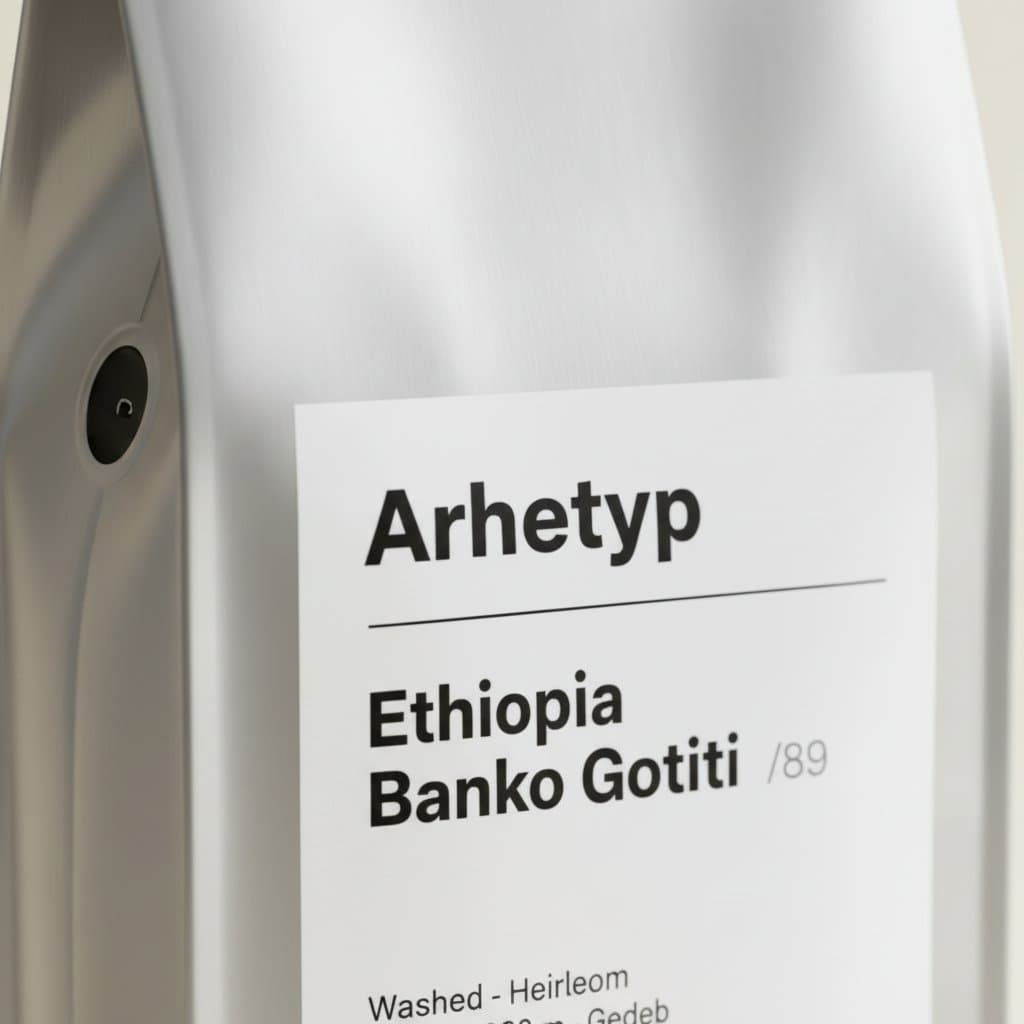
Every coffee has an archetype. The seed carries a fixed set of acids, sugars and aromatic compounds. Variety, altitude and processing set that inventory before the bean ever reaches us. Roasting either reveals it or covers it.
We roast light because we want the origin to arrive intact. Light roast is a decision about where to stop. We end development shortly after first crack, around 200 to 205 degrees Celsius of bean temperature. A darker roast pushes to 220 or higher. Those 15 to 20 degrees change almost everything in the cup.
This is not a preference dressed up as a philosophy. It is a measurable choice with measurable results. Below we lay out the chemistry, the profile, the brewing, and the two myths that follow light roast around.
Less caramelisation, more of the origin
Heat drives two reactions inside the bean. Maillard browning, active from roughly 150 degrees, builds nutty, bready and cocoa notes. Caramelisation of sugars, active above roughly 170 degrees, builds the roasted, bittersweet layer most people call coffee flavour. Both scale with time and temperature.
A darker roast adds more of that shared roast character. It also breaks down the acids and the volatile aromatics that separate one origin from another. Chlorogenic acids degrade. Citric and malic acid drop. By the second crack, an Ethiopian and a Colombian sit close together on the cupping table, because most of what remains is roast, not origin.
Stopping earlier keeps those acids in play. It preserves the florals, the fruit and the tea-like structure that a farm worked years to build. A washed Ethiopian keeps its jasmine and bergamot. A natural keeps its blueberry and stone fruit. The Ethiopia Banko Gotiti we roast holds that clarity only because we do not push it dark.
Put simply, roast flavour is additive and generic. Origin flavour is fragile and specific. Every degree past first crack trades one for the other.
This is why tasting vocabulary shifts with roast level. Dark roasts share a language of chocolate, toast and smoke. Light roasts split into precise notes: jasmine, bergamot, red apple, blackcurrant, brown sugar. Those notes are not marketing. They are aromatic compounds that survive a shorter roast and would burn off in a longer one.
What the Nordic profile means
The Nordic profile is a light-roast approach shaped by Oslo and Stockholm roasters over the last two decades. The colour is pale, often measuring 80 or higher on the Agtron scale where a dark roast sits near 45. The development time after first crack is short, roughly 15 to 20 percent of total roast time.
The target is transparency, not body. This style assumes filter brewing and good green coffee. It leaves little roast flavour to hide behind, so a defect in the raw bean shows immediately. That constraint is the point. It forces quality at the farm and precision at the roaster.
It also changes how we read a roast curve. We watch the rate at which bean temperature climbs and keep it falling gently through first crack. A stalled curve tastes flat. A rushed one tastes green and grassy. The window is narrow, and we log every batch to stay inside it.
Light roast parameters we target
- Charge to first crack
- roughly 8 to 10 min
- First crack
- around 196 °C
- Drop temperature
- 200 to 205 °C
- Development time ratio
- 15 to 20%
- Total roast time
- 9 to 11 min
- Agtron (roast colour)
- 80 or higher
Figures vary by machine, batch size and green density. We treat them as targets, not fixed rules, and adjust per lot.
How to brew it: filter and hotter water
Light roasts are denser and less soluble than dark roasts. The cell structure stays more intact, so the bean gives up its compounds slowly. Extraction needs more energy. Two levers matter most: water temperature and grind size.
Use water at 94 to 98 degrees Celsius. For very light roasts, stay near the top of that range. Grind a touch finer than you would for a medium roast, and keep the grind even. A filter method such as V60 or a flat-bottom dripper suits the style, because the paper removes oils and sharpens clarity.
Aim for an extraction yield of 20 to 22 percent and a brew strength near 1.35 percent dissolved solids. You do not need a refractometer to get there. Taste is enough. If the cup is thin and sharp, extract more. If it is heavy and dull, extract less.
Agitation is the third lever, and the easiest to forget. Stirring the bloom and pouring with a steady stream both raise extraction. Water quality matters as well. Aim for around 70 to 120 milligrams per litre of dissolved minerals, since very soft water tastes flat and very hard water mutes acidity.
V60 recipe for light roast
- Coffee
- 15 g
- Water
- 250 g
- Ratio
- 1:16.7
- Grind
- medium-fine
- Water temperature
- 96 °C
- Bloom
- 45 g water, 40 s
- Pours
- two, to 150 g then to 250 g
- Total brew time
- 2:30 to 3:00
- Target extraction
- 20 to 22%
If the cup reads sharp or empty, grind finer or raise water to 98 degrees. Sourness is usually under-extraction, not the roast.
Two myths worth clearing
First myth: light roast is sour. Acidity and sourness are not the same thing. A correctly extracted light roast reads as bright and structured, closer to citrus or apple than to vinegar. That brightness is the malic and citric acid doing its job.
Aggressive sourness almost always means under-extraction. The water pulled the fast, acidic compounds and stopped before the sugars and body followed. The fix is mechanical, not a change of coffee: grind finer, raise water temperature, or lengthen contact time. Correct the extraction and the sourness resolves into fruit.
Second myth: dark roast has more caffeine. Caffeine is stable at roasting temperatures and barely degrades. Measured by weight, light and dark roasts carry near-identical amounts. The confusion is density. Light beans are heavier per scoop, dark beans measure larger per gram. Dose by mass and the caffeine is effectively the same.
Freshness and the harvest
Light roast rewards fresh coffee. With less roast character to lean on, age shows quickly. Aromatics fade, and the cup flattens within weeks rather than months. We print a roast date on every bag and work with the current harvest.
Green coffee has a season. A fresh crop carries more of the acids and aromatics that light roasting protects, so we buy against the harvest calendar rather than holding stock for a year. For filter, rest the beans 7 to 14 days after roast to let carbon dioxide off-gas, then brew within about six weeks.
Store them sealed, away from light and heat, and grind at the moment of brewing. The single origins in the shop rotate as new lots land, so the offer follows what is fresh rather than a fixed list.
There is a practical test for freshness. A fresh light roast blooms visibly, doming and bubbling as carbon dioxide escapes on the first pour. A flat bloom means the coffee is old or the water is too cool. That small reaction tells you more about the bag than any label does.
Back to the archetype
Coffee has an archetype, and our job is to state it clearly. Light roasting is how we keep the origin legible in the cup. The single origins carry that idea in its purest form. The Casa No. 7 blend applies it to a balanced, everyday profile for filter and espresso alike.
Roasting light is not a style layered on top of the coffee. It is the shortest path between the seed and what you taste. We measure the roast in degrees and seconds so the origin does the talking.